

Your business does not have 100 problems. Only one
The real reason your business is not moving forward.

This might sound stupid or obvious. But the truth is, we do not know what we do not know until we have to face it.
For a long time, I believed business problems were solved by adding more solutions. More leads, more people, more tools, more processes. But the result was almost always the same: more complexity, more noise, and very little real impact on results.
Every entrepreneur reaches a point where, no matter what they do, they feel stuck. You try many things, but you still feel stuck. No matter what you do, you do not move forward.
Everything changed for me when I understood a simple principle that now guides almost all my operational decisions.
A business does not fail due to a lack of effort. It fails because it optimizes things that do not matter.
That is when I learned the concept called “Theory of Constraints” or Teoria de las Restricciones.
The central idea is simple, and once you understand it, it is hard to stop seeing it everywhere. This methodology talks about four truths within the anatomy of a business.
First truth: Every business is a system with flow
It does not matter if you sell services, software, physical products, tacos, or knowledge. Every business is a system that takes something on one end and generates money on the other.
Between those two points there are stages, people, decisions, and handoffs. You can imagine it as a pipeline with an input and an output, and inside that pipeline there are bottlenecks of different sizes.
That flow never moves at the system’s average speed. It always moves at the speed of the slowest point. It does not matter how well everything else works. If one part is slower, the entire system adjusts to that pace.
This is where I messed up for a long time. When I did not see progress, my natural reaction was to do more things. Bring in more leads, more traffic, hire more people, more products or services. But if the bottleneck was in the middle or at the end of the pipeline, none of that increased results or solved the problems. On the contrary, it made them worse.
I ended up with more internal pressure and false signals of progress that only made me believe I was moving forward, when in reality I was not.
Second truth: The system only has one real problem at a time
One of the most counterintuitive lessons for me was understanding that, at a given moment, a business is only limited by one real problem at a time. Not by many, not by everything, not by an endless list of pending things.
That point is the constraint. Everything else is secondary.
As a business owner, this is deeply liberating. Even if you feel like you spend the day putting out fires, there is really only one that truly matters. Understanding that removes a huge mental load.
Once you see it this way, investing time outside that constraint clearly becomes a waste of time. I stopped asking myself “what can we improve” and started asking myself “what is limiting the final outcome”.
That change in perspective reveals uncomfortable things. Many times, the constraint does not live where we usually look first.
It shows up in how decisions are made, in who has implicit permission to stop something, in how long it takes for a signal to be interpreted as relevant, or in how many layers exist between a problem and the person who can solve it.
Another common mistake is thinking the constraint is always on the operational side. Many times it is not. I have seen systems where the brake is not in production, or in sales, or in delivery, but in the way things are prioritized. When it is not clear which constraint truly matters today, as opposed to what can wait, the entire system slows down.
The Theory of Constraints forces you to make a distinction almost no one makes: not every problem deserves attention at the same time.
Third truth: Optimizing outside the constraint not only does NOT help, it makes things worse
For a long time I confused progress with being proactive. When something was not working, my instinct was “improve the system”. Make it clearer, more professional, more sophisticated. It felt like I was moving forward and gave me the sense I was doing the right thing as a founder.
The problem is that many of those improvements were not connected to what was truly holding the business back. And that is where it gets dangerous. Optimizing something irrelevant is not a neutral action, it has consequences. Every unnecessary improvement adds layers of complexity, more things to maintain, more decisions to coordinate, and more mental energy invested in sustaining something that does not move the final outcome.
Over time I understood that many times I was not solving problems, I was decorating them. Making the system more complex without realizing it.
I stopped “solving” ghost problems and started focusing on what truly moves the business. I accepted that there are moments when improving processes, adding tools, or structure not only does NOT help, it ends up making everything slower later.
Today I am much more intentional. I no longer ask myself if solving a problem is a matter of logic or a tactical solution, I ask myself if it has a direct impact on the result that is being blocked today. If nothing is broken, I do not touch it. Not because simply ignoring problems is a good idea, but because doing it too early often becomes expensive.
Fourth truth: Solving a constraint creates the next one
There was a stage where I felt the business was never “ready”. I fixed something and another problem appeared. There was always a sense that something was missing, as if stability never arrived.
What I did not understand is that feeling was not a bad thing. On the contrary, it was a sign of progress.
A growing business does not stay still. It changes shape. And every change brings a new bottleneck. Something that did not exist before because the system was smaller now shows up because the business is operating at a different level.
Frustration comes when you expect problems to disappear. Clarity comes when you accept that they only transform.
That is where I adjusted my expectation as a founder. I stopped looking for the point where everything flows without friction and started reading problems as information. Each new constraint told me something different about the stage of the business and what now required attention.
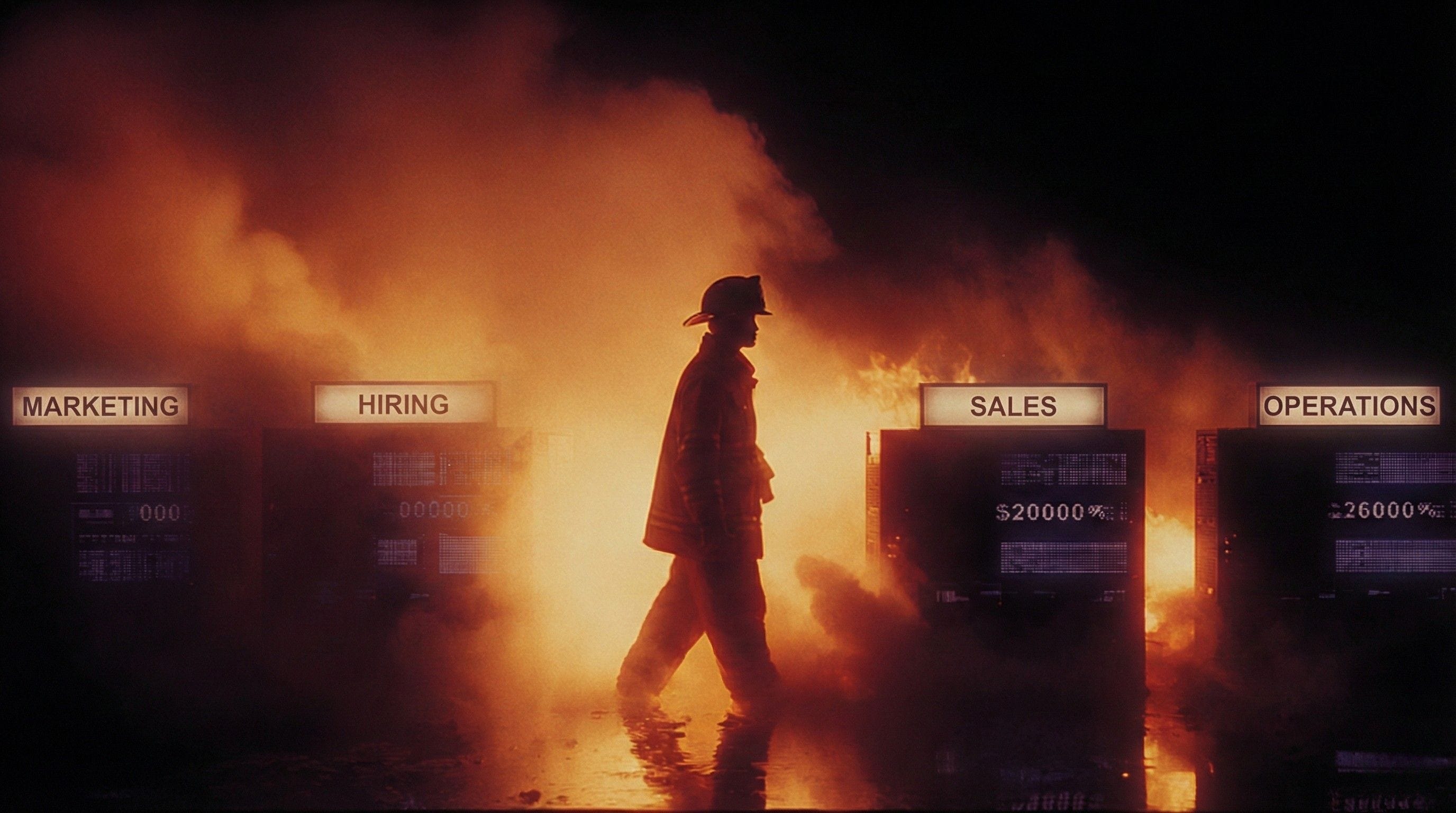
It is not about seeing yourself as a firefighter running after every fire you see, or about solving the same problems over and over again. It is about finding that one problem that matters today.
When you see it this way, new constraints stop feeling like setbacks. They feel like the natural price of moving forward. And that completely changes how you live the day-to-day as a founder.
The real value of the Theory of Constraints
More than a methodology, it is a way of thinking. One that forces you to look the business in the face and accept an uncomfortable but liberating truth:
NOT EVERYTHING DESERVES YOUR ATTENTION AT THE SAME TIME.
There will always be too many things competing for your attention and too many problems that seem to have the same level of urgency, just remember that at the end of the day you can only solve one problem at a time.
The Theory of Constraints helped me understand where to put my energy. When you know what the constraint is, many conversations stop being relevant, many ideas stop being a priority, you save time and a lot of money.
Now I make fewer decisions, but I make them with much more clarity. I do not panic like before. But the most important part of all this is to communicate and train my team to think from the Theory of Constraints and not from a reactive place.
Learning to choose your battles, in the end, is one of the most important skills a founder can develop.
